Bloggers.com

I'm listed in Life & Lifestyle

Cattails in the WInd

Cattails in the WInd

Home Town Canada

Georgetown, Ontario's Hometown Canada Community
Community information including businesses, real estate, travel, events, history, trivia, classified ads, forums and more.

Followers

BlogCatalog

Personal Blogs - BlogCatalog Blog Directory
Showing posts with label Turkey Buzzards. Show all posts

Can you see him? Camera Critters

Posted by Lorac Saturday, 25 September 2010 12 comments

While driving up to my sons, a few klm's north of here, I saw a huge bird on the side of the road eating road kill. As I past I realized it was a Turkey Buzzard. I went back but it flew up into the forest. Can you see him? How many times would one drive by and never see him sitting as he is?


 He has seen me, I don't want to spook him.


Let me bring him a little closer.


Very ugly up close, but beautiful in flight, the Turkey Buzzard (Vulture) is a large bird. It has a wingspan of 170–183 cm (67–72 in), a length of 64–81 cm (25–32 in), and weight of 0.85–2.26 kg (1.9–5 lb). It has dark brown to black plumage; a featherless, purplish-red head and neck; and a short, hooked, ivory-colored beak. Its life expectancy in the wild ranges upward of 16 years, with a captive life span of over 30 years being possible.

The Turkey Buzzard is a scavenger and feeds almost exclusively on carrion. It finds its meals using its keen vision and sense of smell, flying low enough to detect the gasses produced by the beginnings of the process of decay in dead animals.
Natures natural road side cleaner!
Many more Camera Critters here!

SkyWatch Friday/Weekend Reflections

Posted by Lorac Thursday, 27 May 2010 41 comments

The skies have been lovely here. Mostly sunny, some cloud  and hot! 31Celsius yesterday! Everything is a vibrant green, nature is flourishing for now. The thought is though, we are going to have a very hot summer with little rain. There is plenty of blue above and green below at Luther Lake.


I love to look at the sky reflected on the water surface. It gives us another world to see, one for the imagination.


A Canadian Beaver swims her way around a pond reflecting the world she lives in.


SkyWatch from Your Skywatch Team: Klaus, Sandy, Wren ,Fishing Guy,Sylvia, great hosts with many wonderful posts. Weekend Reflections  is hosted by James at Newtown Area Photo.

Luther Marsh

Posted by Lorac Monday, 24 May 2010 20 comments

I was deserted this weekend! I was supposed to get up to the cottage but the rest of my family had made alternate plans and as I can't get the boat in the water alone I decided to just stay home. Everyone has gone off somewhere so it was too quiet and boring! I decided to go hunting yesterday and it turned out to be a good days hunt! I got beaver, turtle, turkey vultures.. Oh, and my hunting is only with a camera! No bloodshed!

I have never been to the Luther Marshes, about an hour and 15 minutes from here. I wanted to go for a walk as well, some where near water as I was missing the cottage andI found this area on line. It is a huge area, 5915 hectares for the Luther Marsh Wildlife Management Area and another 1582-hectare for the Luther reservoir. Today, the Luther Marsh Wildlife Management Area is a core of wetland habitats, including bogs, fens, swamps and marshes, augmented by a patchwork of upland forests, plantations, grasslands, rented farm fields, and recently restored habitats, which together make this the largest "core area" of primarily natural habitat in the watershed.

When I first entered I saw a lake. I didn't expect a 1,400 hectares lake in this area. I thought it was all going to be marshy and boggy. Luther Lake is shallow though and very weedy and full of stumps. It is man made from the headwaters of the Grand River watershed by a damn. Make sure to enlarge these photos for a better look!


There is a nice 6klm walk along the waterfront I followed.


There were many of these. Not sure what they are but think there is a nest in the ground. I f you know what they are, please tell me! Some had way too tiny an opening to be snake or animal. Thinking it is from some kind of insect, possibly wasps.


 There were hundreds of Dragon Flies flying all around.


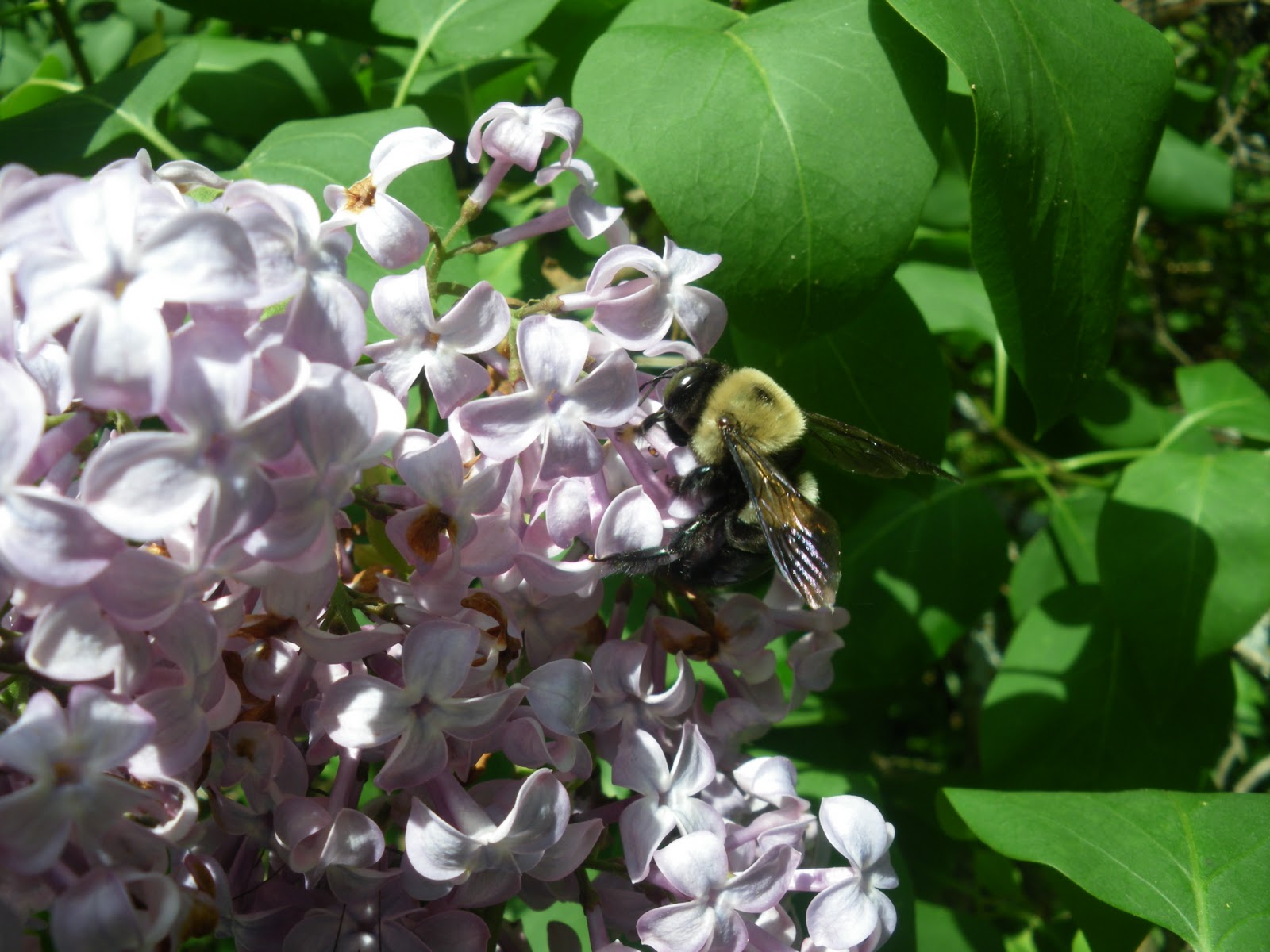
The path veers away from the lake and goes through a forested area. Here there were several wild lilac trees that  were attracting butterfies and bees.


I love to see the Bumble Bees at work!


The path through the woods was so beautiful and vivid green, lined with many kinds of wildflowers.


After my walk, I decided to drive around the area. This whole area has many bogs, swamps , marshes and wetlends.  I saw this little guy sunning on a log in a pond just off road. Looked like a common box turtle. There was another that jumped into the water as soon as I got out of my car.


As I was driving by this small pond I saw rings in the water.  I stopped, expecting I would see fish.


 Then I realized I was being watched. There was a baby too but it swam away into the bushes quickly.
The mother stayed for several minutes, intermittently diving and eating. She was not concerned about me in the least. You can plainly see her broad Beaver tail. Should she have been alarmed, she would have slapped it on the water hard as a sign for everyone to run for cover. Finally, she swam off into the bushes to follow her young one.


There were many marshes and little ponds and I saw lots of water fowl. I continued to drive around the wetlands and saw such beautiful farmland, with soil so rich! At one farm I saw an old barn and a couple of large birds sitting on a pile of old wood. Looking more closely  I saw they were Turkey Buzzards. I stopped my car and got out quietly hoping for a couple of pics. Surprisingly they didn't fly away.


 I started into the field when I realised there wasn't two birds but four!


Then I Saw two more a little ways over on the wood pile. There were 6!


I had continued to walk slowly through the field towards these great birds. When I was about 75 feet away, they took to the skies and soared around my head. I couldn't focus fast enough to get any good shots, but managed a couple.


Just down the road, another shallow little lake.


I spent 7 hours on this trip and took 176 photos. More for another time!

Have a wonderful week!

Haliburton Wildlife Part Three - Raptors!

Posted by Lorac Tuesday, 16 June 2009 5 comments

I have had a few surprises while researching this. What I thought was going to be an easy post has turned out to be a few difficult posts.There are a lot more animals than I originally thought about. I have also learned some really interesting facts about our wildlife.I recommend to anyone in any area to look up your wildlife and have a read. You may be surprised too!
I am going to delve into the feathered wildlife for this post. And surprise surprise! There are also too many to cover so I will once again cover the more common ones. I shall start out with the Raptors! No, not the dinosaurs or the Toronto basketball team. The word Raptor comes from a Latin word meaning to seize or plunder. Today Raptor is used to describe a group of birds prey. All raptors have a strong hooked beak,sharp talons, keen eyesight and a carnivorous diet.
Once again I will start big to small.

Bald Eagle - These birds are the largest bird in Ontario and increasing in numbers. Their wing span is 2 meters in length. The Bald Eagle feeds primarily on fish, aquatic birds, and mammals, which it may take alive or find dead. Much of its live prey, especially the waterfowl, consists of sickly individuals or those wounded by hunters. When its staple foods are not available, a Bald Eagle will eat almost anything that has food value. The nest is the largest of any bird in North America; it is used repeatedly over many years and with new material added each year may eventually be as large as 4 metres (13 ft) deep, 2.5 metres (8.2 ft) across and weigh 1 tonne. One nest in Florida was found to be 6.1 metres (20 ft) deep, 2.9 metres (9.5 ft) across, and to weigh 2.722 tonnes (3.0 short tons).The nest is built out of branches, usually in large trees near water


Turkey Vulture- Ugly as sin close up but the most beautiful glider of them all. This vulture has a large wingspan with a smaller body.The Turkey Vulture is a large bird. It has a wingspan of 170–183 cm (67–72 in), Turkey Vultures are carrion feeders and so they like roads. Lots of carrion there. As the roads have expanded up in cottage country, so have the Turkey Vultures. Spends most time soaring, infrequent flaps are slow and laborious. Has a long rounded tail .Eggs are generally laid in the nesting site in a protected location such as a cliff, a cave, a rock crevice, a burrow, inside a hollow tree, or in a thicket. There is little or no construction of a nest; eggs are laid on a bare surface.


Osprey - It is a large raptor reaching 60 centimeters (24 in) in length with a 1.8 metre (6 ft) wingspan. the Osprey's diet consists almost exclusively of fish.occasionally, the Osprey may prey on rodents, rabbits, hares, amphibians, other birds and small reptiles. The Osprey breeds by freshwater lakes,The nest is a large heap of sticks, driftwood and seaweed built in forks of trees, rocky outcrops, utility poles, artificial platforms or offshore islets.


Northern Harrier - The Hen Harrier is 45–55 cm long with a 97–118 cm wingspan. It resembles other harriers in having distinct male and female plumage's. The sexes also differ in weight, with males weighing an average of 350 g and females an average of 530 g. This medium-sized raptor breeds on moorland, swamps and bogs. The nest is on the ground. Four to six whitish eggs are laid. Harriers hunt small mammals and birds surprising them as they drift low over fields and moors.


Barred Owl - The Barred Owl is a large owl. It goes by many other names, including eight hooter, rain owl, wood owl, and striped owl, but is probably known best as the hoot owl .The adult is 44 cm long with a 112 cm wingspan. Breeding habitat is dense woods across Canada The diet of the Barred Owl consists mostly of mice of many species, but it also feeds on rabbits, chipmunks, possum and also birds such as grouse and doves. It occasionally wades into water in order to capture fish. Barred Owl's nest is often in a tree cavity; it may also take over an old nesting site used by a crow or squirrel.


Great Gray Owl -The length ranges from 61 to 84 cm (24 to 33 in), averaging 72 cm (27 in) for females and 67 cm (26 in) for males. The wingspan can exceed 152 cm (60 in),heir breeding habitat is the dense coniferous forests, near open areas, such as meadows or bogs. Great Grey Owls do not build nests, so typically use nests previously used by another large bird, such as a raptor.They will also nest in broken-topped trees and cavities in large trees.They have excellent hearing, and may locate (and then capture) prey moving beneath 60 cm (2 feet) of snow in a series of tunnels solely with that sense. These owls can crash through snow that could support the weight of a 180-pound person. Unlike the more versatile eagle and horned owls, Great Grey Owls rely almost fully upon small rodents with voles being their most important food source. Locally, alternative prey animals (usually comprising less than 20% of prey intake) include
hares, moles, shrews, weasels, thrushes, grouse, Jays, small hawks and ducks.


Short Eared Owl Short-eared Owl, is a medium-sized owl averaging 34–43 cm (13 to 17 inches) in length and weighing 206–475 grams (11 to 13 ounces). Wingspans range from 85 to 103 cm (38 to 44 inches). Females are slightly larger than males. The Short-eared Owl nests on the ground in prairie, tundra, savanna, or meadow habitats. Nests are concealed by low vegetation, and may be lightly lined by weeds, grass, or feathers Its food consists mainly of rodents especially voles but it will eat other small mammals and some large insects. Sometimes it even tends to eat smaller birds.

Blog Widget by LinkWithin

Canadian Please!

Powered By Blogger

About Me

My Photo
Lorac
Georgetown, Ontario, Canada
I have lived in Georgetown for 37 years but have traveled around a great deal. I own my own business which takes a lot of my time but try to blog as much as possible! I love to take pictures, no training, just a love of photography. Enjoy the pics but please do not copy them.
View my complete profile

Please do not copy!

Copyright ~~All content and photos are original to Carol Merten, Ahhh...The Cottage Life! and are copyrighted. Please do not copy, or download any content without express written consent. All content and photos remain the sole property of Carol Merten.

Visitors